 AVAIRY SOLUTIONS
911 Dispatchers Are Working 16-Hour Shifts. Here's What We Can Take Off Their Plate.
On October 14, the 911 administrator in Cayuga County, New York, told county legislators that his center had already logged 311 overtime hours that month. Dispatchers were being scheduled for 16-hour double shifts because nobody else was available to cover them. Another dispatcher had just given notice. The committee chair put it plainly: “It’s an emergency, folks.”1
Cayuga County isn’t an outlier. In Oakland, California, the police department is budgeted for 78 dispatchers and has 66 of those jobs filled. Once you subtract people on leave and people still in training, overtime is covering 27 positions, about a third of the floor. The department’s communications unit went through more than $2.6 million in overtime last year, and a shift there can stretch to 16 hours.2 In May, dispatchers in Albuquerque went to their city council to describe 16-hour shifts with eight hours off before the next one.3
I spent just over 14 years in law enforcement full time and another 14 as an auxiliary officer, so let me say this first: dispatchers are never the problem. There just aren’t enough of them, and the people who are still there are carrying the difference.
How big is the shortage?
The honest answer is that the best national numbers are a few years old. I couldn’t find a newer national count of vacancies than the ones below, though this year’s local reporting gives no sign that the problem has gone away.
- A survey by the International Academies of Emergency Dispatch and the National Association of State 911 Administrators drew responses from 774 centers. It found that about one in four positions sat vacant between 2019 and 2022.45
- In that same survey, 271 centers reported vacancy rates of 30% or higher, and 13 of those had at least 70% of their positions empty. Respondents counted 3,952 departures in a single year.4
- In the 2024 Pulse of 911 survey from NENA and Carbyne, 75% of centers said they didn’t have the budget to add staff. Of the centers that did have the money, 82% still had trouble filling jobs.6
Why hiring alone won’t fix next week’s schedule
Hiring matters, and it does work. Portland, Oregon, is the proof. Its vacancies dropped from about 33 in 2022 to six, and the average wait for a 911 answer fell from 77 seconds to 18.7
But look at what that took. Portland’s auditor found that about 46% of dispatcher trainees were terminated or resigned, which the auditor says is in line with national estimates. An 18-month training run costs about $137,000 in wages and benefits alone, and trainees took more than 26 months on average to certify in all three disciplines.8
So a center that does everything right today may wait a year or two before that new hire is fully qualified. In Cayuga County, the committee chair said it can take 15 months.1 Somebody has to work those shifts in the meantime, and it’s usually the people who are already tired.
What those hours do to people
A University of Washington team looked at this directly. In their study of 403 telecommunicators, 47.6% reported being required to work mandatory overtime. More mandatory overtime hours went along with more symptoms of stress. Voluntary overtime didn’t show that link.9 That detail stays with me. It isn’t only the hours. It’s also not having a say in them.
A 2024 review pooling research on emergency call-handlers and dispatchers put PTSD at 17.8% and depression at 28.2%. The general-population figures the authors compared those against were 3.9% and 10.6%.10 And Oakland’s city auditor found that longer shifts exhaust dispatchers and make errors more likely.2 That’s a safety problem for officers and callers as well as a staffing one.
The part of the workload we can actually change
You can’t take the emergencies off a dispatcher’s plate, and nobody should try. But a lot of what fills a shift isn’t an emergency.
Charleston County, South Carolina, handled nearly 300,000 emergency calls in 2022 and about 370,000 administrative and non-emergency calls. When the center was about half-staffed in early 2023, cutting those calls became a top priority. Tow companies alone had been calling more than 12,000 times a year.11
In a lot of centers, those calls ring the same people working the radio. The national standard is clear about the order: answer 911 first, then the non-emergency line, then administrative lines.12 That’s the right order. It also means the person asking about a towed car waits, then gets a dispatcher who was just pulled away from something else.
Moving those calls somewhere else does help. Arlington County, Virginia, reports that AI handling of administrative calls saved 829 hours in its first quarter, or about nine hours a day. Emergency calls stayed with people.13
Where Guardian Switchboard fits
This is the problem we built Guardian Switchboard to work on. It answers an agency’s non-emergency and department lines, around the clock, on the numbers people already call. It doesn’t answer 911.
- The routine question gets answered. Your agency teaches it things like fingerprinting hours, how to get a report copy, and where the lobby is.
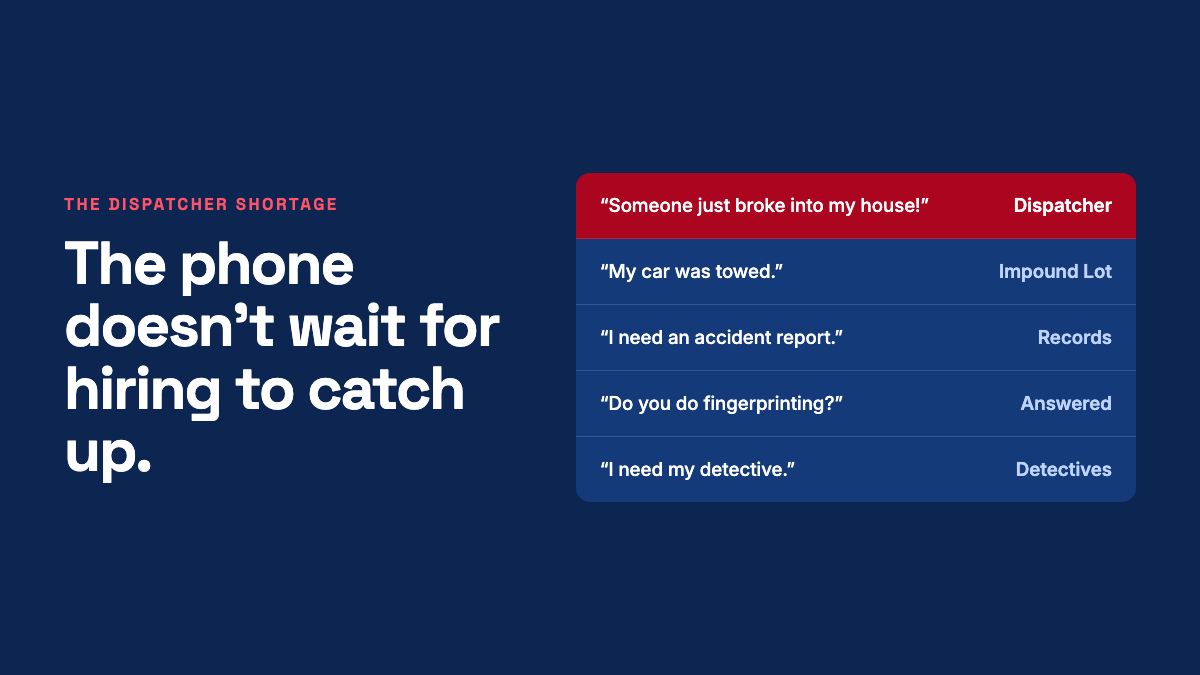
- The routine call goes to the right place. Records, detectives, the impound lot, or whichever office actually handles it. Your agency decides the routing.
- The real emergency goes to a person. A crime in progress or a frightened caller gets handed to a person mid-conversation. Silence on the line is treated as an emergency. When in doubt, the call goes to dispatch.
- Every call is documented. Each one has a transcript, a recording, and a summary your supervisors can review.
In our deployments, we’ve seen an immediate 20–30% drop in calls reaching dispatch. In the first 385 days at one police department we serve, 7,257 of 28,805 real conversations never needed to reach the floor. That’s about 19 calls a day: dogs, potholes, tow releases, records requests, and power outages. About three of every four conversations still went to dispatch, and that’s the system doing its job.14
Nineteen calls may not sound like much until you think about what each one interrupts. If you’ve got two people on the floor and one is talking an officer through a traffic stop, that’s 19 fewer times a day the other one has to break away.
What it won’t do
Switchboard won’t hire anyone. It won’t raise pay, and it won’t end mandatory overtime by itself. We haven’t measured an overtime drop at our agencies, so I’m not going to claim one. Agencies still need to recruit, train, and pay people what this work is worth.
What it can do is make the shift someone is working tonight a little less interrupted, so that hour 14 has fewer calls about a barking dog in it. Your dispatchers keep the emergencies. We’ll handle the day-to-day.
If you’d like to hear it, book a 20-minute demo and we’ll run a live call on your own non-emergency line.
Sources
- “Cayuga County 911 dispatchers face double shifts as another employee resigns.” FingerLakes1.com, October 18, 2026.
- Eli Wolfe, “Oakland is struggling to field 911 dispatchers.” The Oaklandside, March 6, 2026.
- “9-1-1 dispatchers describe forced 16-hour shifts and ask council for scheduling and pay changes.” Citizen Portal summary of the Albuquerque City Council meeting, May 26, 2026.
- Leila Merrill, “Study: Staffing an issue for nearly 50% of 911 dispatch centers.” EMS1, March 2, 2023, reporting on the IAED/NASNA Staffing Survey Report, 2023.
- “‘Difference between life and death’: Inside the staffing crisis at 911 dispatch centers.” ABC News / Good Morning America, July 19, 2023.
- “Survey Suggests Difficulties Continue for 911 Call Centers.” GovTech, April 12, 2024, reporting on the 2024 Pulse of 911 survey by NENA and Carbyne.
- “Portland 911 call wait times improving, audit finds.” OPB, June 24, 2026.
- Portland City Auditor, “Emergency Communications has dramatically improved 911 staffing and call wait times; further efforts could help avoid setbacks.” June 24, 2026.
- Park S, Meischke H, Lim S. “Effect of Mandatory and Voluntary Overtime Hours on Stress Among 9-1-1 Telecommunicators.” Workplace Health & Safety, 2024;72(1):21-29.
- Osório C, Talwar S, Stevelink SAM, Sihre HK, Lamb D, Billings J. “Systematic review and meta-analysis on the mental health of emergency and urgent call-handlers and dispatchers.” Occupational Medicine, 2024;75(6):282-291.
- David Slade, “Charleston County diverts 1,000s of non-emergency calls to ease burden on 911 operators.” The Post and Courier, December 23, 2023.
- NENA-STA-020.1-2020, sections 2.2.1 and 2.2.2, as published by Morgan County 911.
- Dominick Sorrentino, “AI Saves Arlington County PSAPs 9 Hours Per Day.” StateTech, 2025.
- AVAIRY Solutions call records for one police department, July 11, 2025 through July 30, 2026. Real conversations exclude hang-ups and dead air.